
You’re mid-inbox, your jaw is tight, and your heart’s doing that shallow, fast thing again. Here’s the short version: specific deep breathing techniques to lower cortisol — like box breathing, extended exhales, and physiological sighs — work by activating your vagus nerve and shifting your body out of fight-or-flight mode. Most take under five minutes, and you can do them at your desk without anyone noticing.
That’s not a maybe. It’s how your nervous system is wired.
Key Takeaways
- Slow, extended exhales (longer than your inhale) are the single most efficient way to calm your nervous system through breathing alone
- Box breathing (4-4-4-4 count) is the most researched technique for quick stress relief breathing exercises for the office
- Most techniques need just 2-5 minutes to produce a noticeable shift in how you feel
- Breathing won’t erase your stressors, but it can lower your reactivity to them — which changes how you show up to the next meeting
- Consistency matters more than perfection — three minutes daily beats one perfect 20-minute session you never repeat
How Does Deep Breathing Lower Cortisol?
Here’s the mechanism, minus the biology-class jargon.
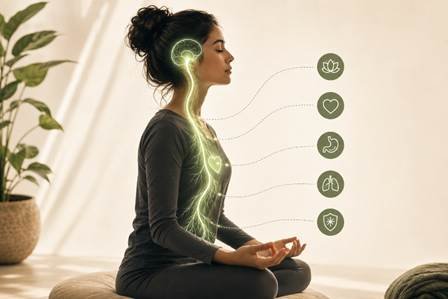
Your body runs on two competing nervous system branches. The sympathetic branch is your gas pedal — it revs you up for stress, deadlines, and confrontation. The parasympathetic branch is your brake — it calms you down, slows your heart rate, and tells your brain the danger has passed.
Slow, deep breathing — especially when your exhale is longer than your inhale — stimulates the vagus nerve, a long nerve that runs from your brainstem down through your chest and gut. Activating it flips on your parasympathetic “brake” system [Peer-reviewed study on vagus nerve stimulation via slow breathing and parasympathetic activation].
When that brake engages, your body gets the signal to dial back cortisol production. Research has shown that slow-paced breathing (roughly 6 breaths per minute or fewer) can measurably lower cortisol levels and self-reported stress within minutes [Study measuring cortisol change from slow breathing practice, ideally with breaths-per-minute data].
I’ll be honest — I used to think this was a bit too simple to actually matter. Surely something as automatic as breathing couldn’t meaningfully touch a hormone your adrenal glands pump out. But the research (and about a decade of watching this work in real people, myself included) changed my mind. It’s not magic. It’s just underused.
1. Box Breathing (4-4-4-4)
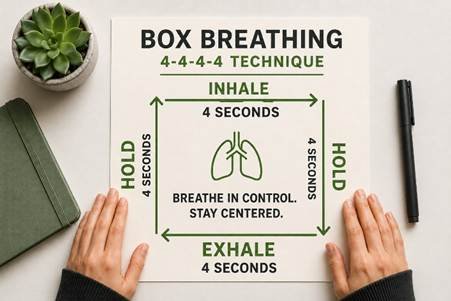
This is the one Navy SEALs supposedly use before high-stakes situations, which is probably why it’s the most searched breathing technique on the internet. It’s also genuinely one of the best for quick stress relief breathing exercises for the office because it’s easy to remember and doesn’t require closing your eyes.
How to do it:
- Inhale through your nose for a count of 4
- Hold your breath for a count of 4
- Exhale slowly through your mouth or nose for a count of 4
- Hold empty for a count of 4
- Repeat for 4-5 rounds
The equal-count structure is what makes it easy to learn under pressure — you’re not doing math, you’re just counting to four, four times. Do it before a hard conversation, a big presentation, or when you feel your patience running out in a meeting.
2. Physiological Sigh
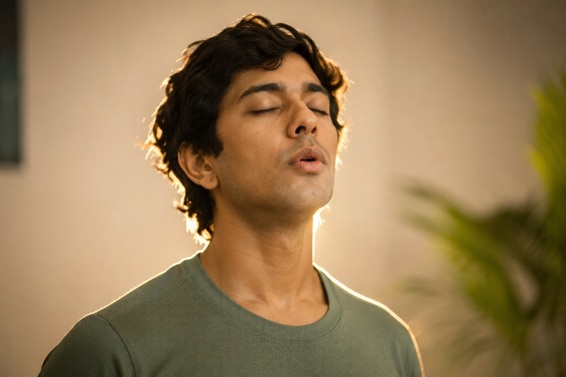
If you only learn one technique from this article, make it this one. Stanford neuroscientist Andrew Huberman’s lab has been especially vocal about this technique’s speed [Study on physiological sigh and rapid reduction in arousal/stress, Huberman lab or similar], and in my experience it’s the fastest reset of anything on this list.
How to do it:
- Take a deep inhale through your nose
- At the top of that inhale, take a second, shorter sharp inhale through your nose (this fully expands collapsed air sacs in your lungs)
- Exhale slowly and fully through your mouth — let it be long and audible
- Repeat for 1-3 cycles
That’s it. One to three cycles. You can do this while reading an email that just made your stomach drop, and nobody around you will know.
3. Extended Exhale Breathing
This isn’t a “technique” so much as a principle you can apply to almost any breathing pattern, and it might be the most important idea in this whole article.
Your exhale is what triggers the parasympathetic response. So if you only remember one rule, remember this: make your exhale longer than your inhale.
A simple version:
- Inhale for a count of 4
- Exhale for a count of 6-8
- Repeat for 2-3 minutes
Try it right now, actually — inhale for 4, exhale for 7. Notice how your shoulders drop a little on that long exhale? That’s the vagus nerve doing its job.
4. 4-7-8 Breathing
Popularized by Dr. Andrew Weil, this one has a bit of a reputation as a “sleep hack,” but it works just as well for daytime stress — it’s just intense enough that some people feel lightheaded the first few tries. Don’t panic if that happens; it usually settles after a few sessions.
How to do it:
- Exhale completely through your mouth
- Inhale through your nose for a count of 4
- Hold your breath for a count of 7
- Exhale forcefully through your mouth for a count of 8
- Repeat for 4 rounds max the first few times
I’ll push back on the internet consensus here a little: most articles tell you to do 8 rounds. I think that’s too many for beginners. Start with 4. You can always add more once your body’s used to the hold.
5. Diaphragmatic (Belly) Breathing
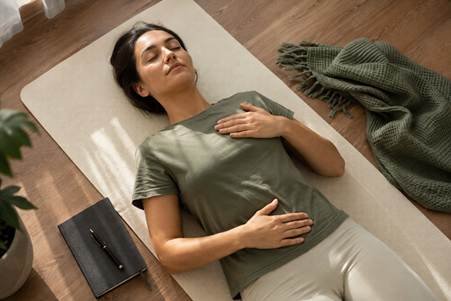
This is the foundation underneath almost every other technique on this list, so it’s worth doing on its own too, especially if you’re a chronic chest breather — someone whose breath barely moves past their collarbone. A lot of desk workers are.
How to do it:
- Sit or lie down, one hand on your chest, one on your belly
- Inhale slowly through your nose, letting your belly rise while your chest stays relatively still
- Exhale slowly, feeling your belly fall
- Continue for 3-5 minutes
If your chest hand is moving more than your belly hand, you’re breathing shallow — and shallow breathing keeps your body subtly primed for stress even when nothing’s actively wrong [Research on chronic shallow/chest breathing and baseline stress or cortisol levels].
6. Alternate Nostril Breathing (Nadi Shodhana)
This one has roots in yogic breathing practice, and I’ll admit it feels a little odd the first time you try it at your desk — you’re literally plugging one nostril with a finger. Save it for a moment when you have a bit of privacy, like right before a break or after you get home.
How to do it:
- Close your right nostril with your thumb
- Inhale through your left nostril
- Close your left nostril with your ring finger, release your thumb
- Exhale through your right nostril
- Inhale through the right nostril
- Switch and exhale through the left
- That’s one round — repeat for 5-10 rounds
Some early research suggests this pattern may help balance activity between the brain’s two hemispheres and lower perceived stress [Study on alternate nostril breathing and cortisol or stress markers], though the evidence base here is smaller than for box breathing or extended exhales.
7. Resonance (Coherent) Breathing

This is the slow, steady one — roughly 5-6 breaths per minute, inhale and exhale close to equal length. It’s less dramatic than the physiological sigh, but it’s the technique with some of the strongest longer-term research behind it for lowering baseline stress hormone levels over weeks of consistent practice [Study on resonance/coherent breathing and cortisol over multi-week practice].
How to do it:
- Inhale through your nose for a count of 5-6
- Exhale through your nose for a count of 5-6
- No holds — just smooth, continuous breathing
- Continue for 5-10 minutes
This is the one I’d recommend for winding down before bed rather than mid-crisis at work — it’s too slow and meditative to want to rush through when you’ve got four minutes before a call.
Which Technique Should You Actually Use?
Honestly? It depends on what you need in the moment, and I’d skip any advice that tells you to just pick one and stick with it forever.
- Mid-meeting panic or a hard email: Physiological sigh
- Before a presentation or hard conversation: Box breathing
- General desk stress, no urgency: Extended exhale
- Winding down before bed: 4-7-8 or resonance breathing
- Chronic shallow breather: Start with diaphragmatic breathing to rebuild the habit
Most people I’ve seen stick with this long-term don’t master all seven. They find one or two that fit their actual day and use those on repeat. That’s fine. Repetition is what builds the response — not variety.
A Quick Note on Limits
Deep breathing is not a replacement for treatment if you’re dealing with chronic anxiety, panic disorder, or a diagnosed stress-related condition. It’s a genuinely useful tool for everyday stress and cortisol spikes, but it’s a tool — not a cure. If your stress feels constant, unmanageable, or is affecting your sleep, appetite, or relationships, talk to a doctor or therapist. Breathing exercises may help alongside that care, but they’re not a substitute for it.
Suggested external links (for E-E-A-T):
- A .gov or .edu source on vagus nerve function and the parasympathetic nervous system
- A peer-reviewed study or major health organization (NIH, Harvard Health, or similar) on slow breathing and cortisol regulation
FAQ
How long does it take for deep breathing to lower cortisol?
Some techniques, like the physiological sigh, may shift how you feel within one to three breaths. Measurable changes in cortisol likely take a few minutes of sustained practice, and the biggest benefits tend to show up with regular daily use rather than a single session [Study on time-to-effect for slow breathing on cortisol or stress response].
What is the best breathing technique for stress at work?
Box breathing and the physiological sigh are usually the most practical for office settings — both are quick, don’t require lying down, and can be done without drawing attention.
Can breathing exercises really lower cortisol, or is that a myth?
It’s not a myth, but it’s also not a guarantee for every person or every situation. Research suggests slow, controlled breathing can lower cortisol and self-reported stress in many people, though individual results vary and it works best alongside other stress management habits like sleep and movement [Source summarizing breathing/cortisol research and effect size variability].
How many times a day should I practice deep breathing for stress relief?
There’s no single magic number, but doing a short session (2-5 minutes) two to three times a day — especially during known stress points like before meetings — tends to build the habit faster than one long session.
Is box breathing better than the 4-7-8 technique?
Neither is objectively “better” — they serve different purposes. Box breathing is more neutral and easier to do quickly under pressure, while 4-7-8 has a stronger calming, almost sedative effect that makes it better suited to winding down rather than staying alert.