
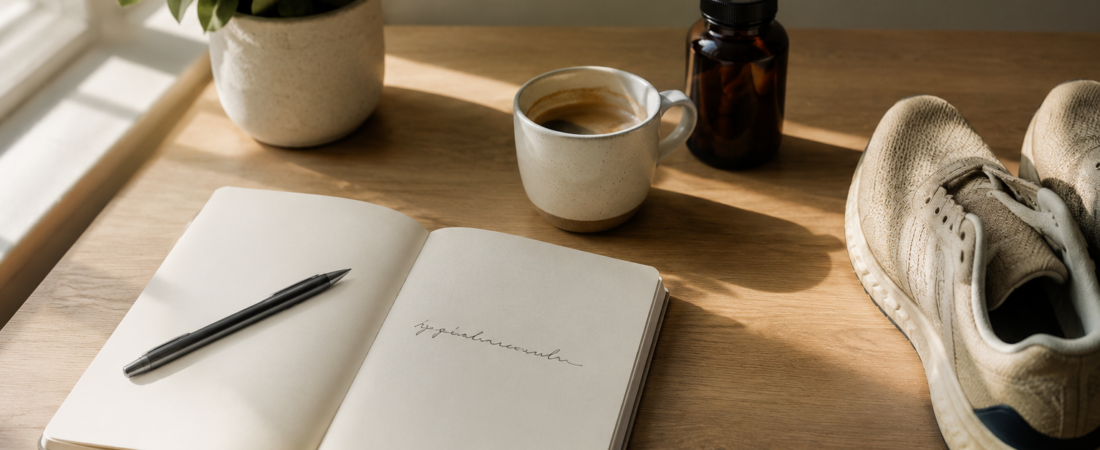
If you’ve ever downloaded a 5 AM routine, followed it for six days, and then quietly let it die — this one’s for you.
Sustainable habits to improve yourself without burnout come down to one idea: pick fewer things, make them small enough that skipping feels harder than doing them, and stop treating rest as something you have to earn. That’s it. No 90-day transformation, no color-coded planner required.
Most self-improvement advice is written by people with a personal trainer, a chef, and no commute. You’re not those people, and you don’t need their system. You need something that survives a bad Tuesday.
Key Takeaways
- Small, boring habits beat ambitious ones. A 2-minute journal entry you actually do beats a 20-minute one you don’t.
- Recovery is part of the habit, not a reward for finishing it. Burnout usually comes from skipping rest, not from working too hard on any single day.
- Stack new habits onto existing ones instead of building your day around them from scratch.
- Track “did I show up,” not “was I perfect.” Consistency beats intensity almost every time [Research on habit consistency vs. intensity in behavior change].
- If a habit needs willpower every single day, it’s not sustainable yet — it just hasn’t failed you yet.
What Does “Sustainable Self-Improvement” Actually Mean?
Sustainable self-improvement means building habits small enough to survive a busy week, flexible enough to bend without breaking, and realistic enough that you’d still be doing them a year from now.
It’s not about doing less because you’re lazy. It’s about doing less because doing more is how you end up doing nothing two months from now. Most self-improvement culture sells intensity — the 75-day challenge, the all-or-nothing reset. That stuff works great for about three weeks. Then life happens: a deadline, a sick kid, a bad breakup, whatever. And because the system had no room to bend, it snaps.
Sustainable habits are the opposite. They’re designed to flex. Missed a day? Fine, that was built into the plan. The goal isn’t a perfect streak — it’s still being here in six months.
Why Most Self-Improvement Advice Burns You Out
Here’s my honest take, and it’s a little unpopular: most productivity and wellness content isn’t designed for you. It’s designed for people who already have margin — time, energy, or money — and are optimizing from a decent baseline.
If you’re a working professional with a full calendar and maybe forty minutes of real free time a day, “just wake up at 5 AM and meditate, journal, and work out before your first meeting” isn’t a habit stack. It’s a part-time job you’re supposed to do for free, before your actual job.
I think the fitness and wellness industry has a bias toward addition. Add a habit, add a supplement, add a routine. Almost nobody talks about subtraction — what you should stop doing so you have room for the one thing that actually matters. That’s the piece most guides skip, and it’s usually the piece that decides whether you burn out or not.
11 Sustainable Habits to Improve Yourself Without Burnout
This is the actual list. Don’t do all eleven. Pick two, maybe three, and give them a month before you add anything else.

- Anchor one habit to something you already do. Brush your teeth, then take your vitamins. Pour your coffee, then write one line in a notes app. This is called habit stacking, and it works because you’re not relying on memory or motivation — you’re relying on a routine that already exists.
- Use the “two-minute floor.” Whatever the habit is, define the smallest version of it — two minutes of stretching, one page of reading, a single set of push-ups. On bad days, you do the floor version. On good days, you do more. The point is the streak, not the volume.
- Protect one buffer block a day, even 15 minutes. This is unscheduled time with no goal attached — not a nap, not a task, just space. Burnout tends to build in people whose calendars are back-to-back with zero gaps.
- Batch your decisions, not your tasks. Decide what you’re eating for lunch, what you’re wearing, and when you’re working out — once a week, not every single morning. Decision fatigue is real, and it eats into the same mental energy you need for actual self-control.
- Set a “good enough” bar for hygiene habits. Sleep, water, and movement don’t need to be optimized. They need to be present. Eight glasses of water is a nice target; not being dehydrated by 3 PM is the actual goal.
- Do a 60-second check-in before bed. Rate your day 1-10, note one thing that went okay. This isn’t journaling in the Pinterest-board sense — it’s closer to a receipt. It takes almost no time and gives you a pattern to look back on after a few weeks.
- Say no to one thing a week that isn’t yours to carry. This could be a meeting you don’t need to be in, a favor you don’t have bandwidth for, or a group chat argument you can skip. Boundaries are a self-improvement habit — they just don’t get marketed that way.
- Move your body for the mood, not the calorie burn. A 10-minute walk after a stressful call does more for your nervous system in that moment than the idea of a future workout ever will. Save the intense training for when you actually have the energy for it.
- Read or listen to something for 10 minutes instead of doomscrolling before bed. You don’t need to finish a book a month. You need one small habit that isn’t a screen feeding you outrage or comparison right before you try to sleep.
- Build in a weekly “reset,” not a daily one. Pick one hour — Sunday afternoon works for a lot of people — to tidy your space, glance at next week’s calendar, and mentally close out the current one. This beats trying to reset perfectly every single night, which nobody actually sustains.
- Track effort, not outcomes, for the first month. Did you show up? That’s the metric. Weight, streak length, and follower counts on your habit-tracking app are outcome measures, and outcomes lag behind effort by weeks. Chasing them too early is a fast way to quit.
[Guide on stopping overthinking]
How Do You Build Habits Without Burning Out?

If you want the short, step-by-step version, here’s the process behind the list above:
- Pick one habit, not five. Willpower is a limited resource. Spread it across five new habits and you’ll likely lose all of them instead of keeping one.
- Shrink it until it feels almost too easy. If your instinct says “that’s not enough,” you’ve probably found the right starting size.
- Attach it to an existing routine. New habits need a cue. Borrow one from your day instead of inventing a new trigger.
- Give yourself a floor version for bad days. Missing the “full” version shouldn’t mean missing the habit entirely.
- Review after two weeks, not two days. Habits feel awkward at first. That’s normal, not a sign it’s the wrong habit.
- Add the next habit only once the first one feels automatic. This usually takes 3-8 weeks, not the “21 days” number you’ve probably heard, which isn’t well supported by the original research it gets attributed to [Source on the 21-days-to-form-a-habit myth and its origin].
Low Effort Habits for Mental Health You Can Start Today
You don’t need a wellness retreat to lower your stress baseline. A few low-effort options that actually hold up:
- Box breathing for 60 seconds before a hard conversation or meeting — inhale 4 counts, hold 4, exhale 4, hold 4.
- Naming what you’re feeling, out loud or in a note, instead of just pushing through it. Simply labeling an emotion can reduce its intensity slightly [Research on affect labeling and stress reduction].
- Getting sunlight within the first hour of waking, even just standing near a window for a few minutes. Morning light exposure is linked to better mood regulation and sleep timing [Study on morning light exposure and circadian mood regulation].
- A single “worry window” — 10 minutes a day where you’re allowed to worry on purpose, so your brain has less reason to interrupt the rest of your day with it.
None of these require an app, a subscription, or a free weekend. That’s kind of the point.
Self-Improvement Tips for Busy Working Professionals (Realistic Version)
If your calendar is already full, self-improvement can’t be one more thing bolted on top. It has to live inside the day you already have.
Use your commute or transition time. The walk to the train, the drive home, the five minutes between meetings — this is dead time most people don’t count, and it’s a great place to slot in a habit that doesn’t need full attention.
Lower the bar on weeks you know will be brutal. If you have a product launch or a big presentation coming up, decide in advance which habits get the “floor version” that week. Deciding ahead of time beats feeling guilty in the moment.
Stop treating rest as a reward you haven’t earned yet. A lot of high performers operate like downtime has to be justified by output first. That’s backwards — rest is what makes the next block of output possible, not a bonus round after it.
Small Daily Habits to Reduce Stress at Work
- Take your actual lunch break, away from your desk, even if it’s 20 minutes. Eating while working keeps your nervous system in a low-grade “on” state longer than it needs to be.
- Close out your day with a 2-minute shutdown ritual — write tomorrow’s top task, close your laptop, physically leave the workspace if you can. This creates a mental boundary between “work mode” and “off mode.”
- Batch your notifications into two or three checks a day instead of constant pings. Every interruption costs you re-focus time, not just the seconds you spent reading it [Research on task-switching cost and interruption recovery time].
- Keep one recurring meeting-free block on your calendar, even 30 minutes, for actual thinking work.
For more on how food choices interact with your stress and energy, the Harvard T.H. Chan School of Public Health’s guide on nutritional psychiatry is worth a read, as is the American Psychological Association’s stress management resources if any of this is pointing to something bigger than habit design can fix on its own.
If you’re dealing with ongoing burnout, persistent low mood, or anxiety that these habits aren’t touching, that’s worth bringing to a doctor or therapist — small habits help, but they’re not a substitute for professional support when you need it.

FAQ
What’s the difference between self-improvement and burnout-inducing self-improvement?
Sustainable self-improvement adds one small, flexible habit at a time and expects some missed days. Burnout-inducing versions usually stack several rigid habits at once with no room to adjust, which works until the first hard week — then it collapses.
How many new habits should I try to build at once?
One, maybe two if they’re genuinely tiny (like drinking a glass of water and taking a short walk). Trying to build five habits simultaneously is one of the most common reasons people quit within a month.
How long does it actually take to build a habit?
Longer than the popular “21 days” claim suggests — most research points closer to a range of a few weeks to a couple of months, and it varies a lot by habit and person. Don’t judge a habit as “not working” after four days.
Can small habits really reduce burnout, or do I need bigger changes?
Small habits won’t fix a genuinely toxic job or an unsustainable workload — no habit tracker solves that. But they can lower your day-to-day stress baseline and protect your energy while you work on the bigger stuff, and sometimes that’s what makes tackling the bigger stuff possible at all.
What should I do if I keep failing at a new habit?
Shrink it. If you’re missing a habit more than half the time, it’s usually a sizing problem, not a discipline problem. Cut it down until it feels almost too small, then build back up from there.