

If you’ve replayed a text message conversation for the fortieth time this week, you already know how exhausting overthinking is. The fastest way to stop overthinking is to interrupt the thought loop with a physical or sensory action — not to “just relax” or think your way out of it, which almost never works. Techniques like the 5-4-3-2-1 grounding method, setting a “worry window,” and physically changing your environment can quiet a racing mind in under five minutes.
This isn’t a therapy referral article. It’s a list of things you can actually do tonight, at your desk, or lying in bed at 1 a.m. staring at the ceiling.
Key Takeaways
- Overthinking is a habit loop, not a personality flaw — and habit loops can be interrupted.
- Physical grounding techniques work faster than “positive thinking” because they redirect your nervous system, not just your thoughts.
- A daily 15-20 minute “worry window” can reduce nighttime rumination by giving your brain a scheduled outlet.
- Nighttime overthinking often has different triggers than daytime overthinking, so the fix is different too.
- If overthinking is interfering with sleep, work, or relationships most days, talk to a doctor or therapist — this article covers self-help tools, not treatment.
Why Do I Overthink Everything?
Overthinking usually isn’t about the thing you’re thinking about. It’s about your brain trying to solve for uncertainty, and getting stuck in a loop instead of landing on an answer.
Psychologists sometimes call this rumination — going over the same thoughts again and again without reaching a resolution [CITE: definition and mechanism of rumination from a clinical psychology source]. Your brain thinks it’s being productive. It’s not. It’s just spinning.
A few common triggers:
- Uncertainty — you don’t have enough information to make a decision, so your brain keeps trying anyway.
- Perfectionism — you’re scared of getting it wrong, so you check and recheck.
- Past experience — something went badly before, and your brain is trying to prevent a repeat.
- Low bandwidth — you’re tired, hungry, or stressed, and your brain has less capacity to shut the loop down.
Here’s the part most articles skip: overthinking often feels useful. It feels like planning, like caution, like being responsible. That’s exactly why it’s hard to stop — you’re not fighting a bad habit, you’re fighting a habit that’s disguised as a good one.
How to Calm an Overthinking Mind: 9 Techniques That Work
You don’t need all nine. Pick two or three and actually use them this week before moving on to the rest.
1. Name the Loop Out Loud
Sounds too simple to work, but say it anyway: “I’m overthinking this.” Out loud, not just in your head.
This works because it pulls the thought out of autopilot and into conscious awareness. Once you notice you’re in a loop, you’ve already started to interrupt it. Try this the next time you catch yourself rereading an email for the fifth time.
2. Use the 5-4-3-2-1 Grounding Technique
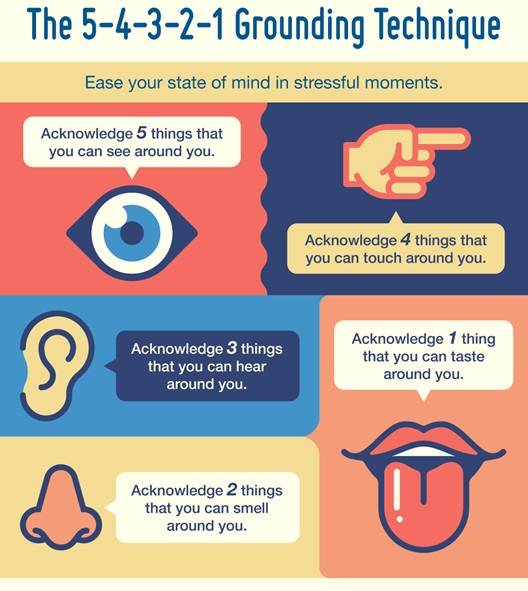
This is one of the most reliable grounding techniques for overthinking, and it works because it forces your brain to process sensory input instead of abstract worry.
Here’s how to do it:
- Name 5 things you can see around you.
- Name 4 things you can physically feel (your feet on the floor, your shirt on your skin).
- Name 3 things you can hear.
- Name 2 things you can smell.
- Name 1 thing you can taste.
It takes about 90 seconds. It won’t erase the worry, but it will pull you out of the spiral long enough to think clearly again.
3. Set a “Worry Window”

Instead of trying to never worry (impossible), give your brain a scheduled 15-20 minute window each day — say, 6:00 to 6:20 p.m. — to think through whatever’s bothering you.
When a worry pops up outside that window, jot it down and tell yourself: “I’ll think about this at 6.” Most of the time, by 6 p.m. it’s either resolved itself or feels smaller than it did at 10 a.m.
This technique has research backing in anxiety treatment programs, where scheduled worry time has been shown to reduce overall rumination [CITE: study on scheduled worry time reducing generalized anxiety symptoms]. It sounds counterintuitive — scheduling more worry to get less of it — but that’s kind of the point.
4. Change Your Physical Position
If you’re overthinking while sitting, stand up. If you’re lying down, sit up. If you’re inside, step outside for two minutes.
Your brain associates certain thought patterns with certain physical states. Changing your body’s position is a cheap, fast way to break that association. I’ll be honest — this one feels almost too easy, but it’s the technique I use the most, mostly because it requires zero setup.
5. Write It Down, Then Close the Notebook

Overthinking thrives on things staying vague and looping in your head. Writing forces the thought into a specific sentence, and specific sentences are easier to deal with than fuzzy dread.
Set a timer for 5 minutes. Write whatever’s bouncing around your head, unfiltered. When the timer goes off, close the notebook. You don’t have to solve it right now — you just have to get it out of the loop.
6. Ask “Will This Matter in 5 Years?”
Not every worry deserves equal airtime. This question is blunt, but it works as a fast filter.
If the answer is no — and for most overthinking spirals, it is — give yourself permission to downgrade it. That doesn’t mean the feeling isn’t real. It means the feeling doesn’t need to run the show.
7. Limit “What If” Chains
Overthinking often moves in a chain: What if I said the wrong thing? What if they’re mad? What if this ruins everything?
Each “what if” adds a new layer of imagined catastrophe, and by the third or fourth one, you’re reacting to a scenario that hasn’t happened and probably won’t. When you catch a chain starting, stop at the first “what if” and ask: is there actual evidence for this, right now? Usually there isn’t.
8. Move Your Body for 10 Minutes

You don’t need a full workout. A brisk 10-minute walk, some jumping jacks, or even vacuuming the living room can lower the intensity of a rumination spiral.
Physical activity increases blood flow and can shift the brain out of the same neural patterns that fuel repetitive thinking [CITE: research on aerobic exercise and reduction in rumination symptoms]. If you’ve ever gone for a walk mid-argument-in-your-head and come back calmer, you’ve already felt this working.
9. Do a “Brain Dump” Before Bed
This one’s specifically for how to stop overthinking at night, since nighttime rumination has its own pattern — your brain finally has quiet space, and it fills that space with everything you didn’t process during the day.
About 30-60 minutes before bed, write down:
- Anything unfinished from today
- Tomorrow’s top 3 priorities
- Any worry currently on your mind
This gives your brain a place to “store” the thought outside your head, which can reduce the 1 a.m. spiral. If you’ve ever lain awake building a to-do list in your mind instead of sleeping, this technique is built for exactly that moment.
How to Stop Overthinking at Night (When Your Brain Won’t Shut Up)

Nighttime overthinking deserves its own section because the fixes that work during the day — going for a walk, changing your environment — aren’t really available at 2 a.m.
A few things that help specifically at night:
- Keep the room cool and dark. Poor sleep environment can make your brain more reactive to intrusive thoughts [CITE: research linking sleep environment quality to nighttime rumination or anxiety].
- Avoid checking the time repeatedly. Every glance at the clock adds a new data point for your brain to worry about (“I’ve only got 5 hours left now”).
- Try the brain dump from technique #9, done earlier in the evening rather than right at lights-out.
- If you can’t fall asleep within 20 minutes, get up. Lying in bed overthinking trains your brain to associate the bed with wakefulness instead of sleep. Go sit somewhere dim, do something boring, and go back to bed once you’re actually tired.
I’ll push back on one piece of common advice here: “just don’t think about it” doesn’t work at night, and telling yourself to stop usually makes the thought louder. The goal isn’t to suppress the thought — it’s to give your brain somewhere else to put its attention.
When Overthinking Might Be More Than a Habit
Most overthinking is just an overactive habit loop. But if you’re dealing with racing thoughts, dread, or rumination most days, and it’s affecting your sleep, work, or relationships, that’s worth mentioning to a doctor or therapist. Persistent, hard-to-control worry can sometimes be a sign of an anxiety disorder, and that’s genuinely treatable — it’s not something you have to just manage alone forever [CITE: NIH or APA source on generalized anxiety disorder symptoms and treatment].
These nine techniques are self-help tools for everyday overthinking. They’re not a replacement for professional support if you need it.
FAQ
What causes overthinking everything?
Overthinking is usually driven by uncertainty, perfectionism, or past experiences where things went wrong. Your brain treats repeated analysis as problem-solving, even when it’s actually just spinning without reaching a decision.
How do I stop overthinking everything in a relationship?
Try naming the loop out loud when you notice it, and ask yourself whether there’s actual evidence for the worry or just an imagined “what if” chain. If the same relationship worries keep resurfacing, that may be a conversation worth having directly with your partner rather than working through alone in your head.
Is overthinking a symptom of anxiety?
Overthinking can be a normal habit, but frequent, hard-to-control rumination is also a common symptom of anxiety disorders [CITE: clinical source distinguishing normal worry from anxiety disorder symptoms]. If it’s persistent and disruptive, a doctor or therapist can help you figure out which one you’re dealing with.
How long does it take to stop overthinking?
There’s no fixed timeline, since it depends on how ingrained the habit is. Most people notice a difference within a few weeks of consistently using grounding techniques or a worry window, though the goal is progress, not perfection.
Can grounding techniques really stop overthinking?
Grounding techniques like 5-4-3-2-1 won’t erase the underlying worry, but they can interrupt the mental loop long enough for you to think more clearly. They work by redirecting attention to sensory input, which pulls your brain out of abstract spiraling.