
Sustainable self-improvement isn’t about waking up at 5 a.m. or rebuilding your whole life in January. It’s a handful of small, low-effort habits that survive your worst weeks — the ones where you’re exhausted, overbooked, and running on coffee and willpower fumes. Most people fail at self-improvement not because they lack discipline, but because they’re using a system built for someone with way more time and energy than they actually have.
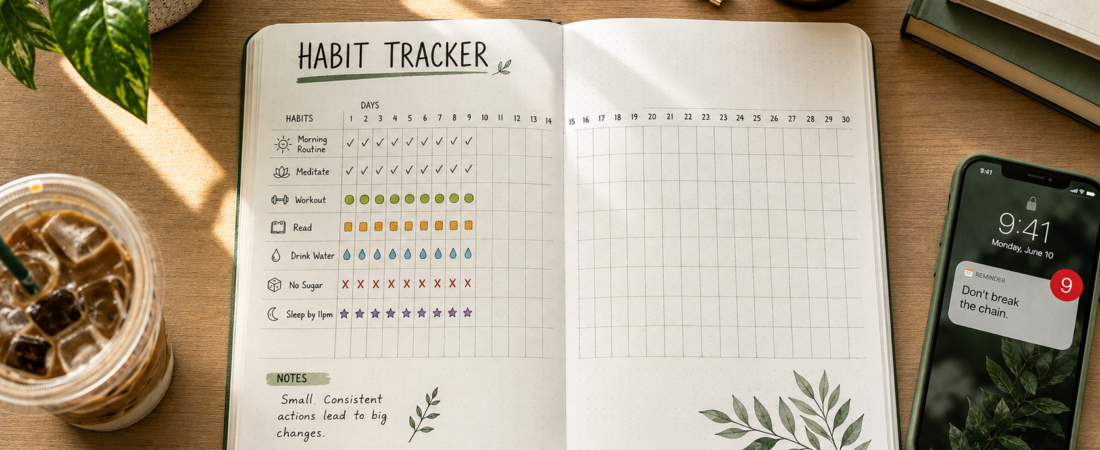
If you’ve ever downloaded a habit tracker, filled it in beautifully for nine days, and then never opened the app again — you’re not broken. You just picked a method that was never going to survive contact with a real week.
Key Takeaways
- Sustainable self-improvement means small, low-effort habits that don’t depend on high motivation or extra time.
- Most habits fail because they’re too big, too rigid, or too dependent on willpower — not because you’re lazy.
- The habits that stick are usually boring, tiny, and tied to something you already do.
- A realistic plan starts with one habit, not five, and expects bad days without falling apart.
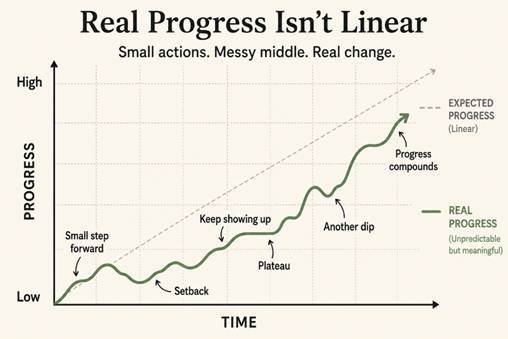
- Progress isn’t a straight line — missing a day doesn’t mean starting over.
What Is Sustainable Self-Improvement?
Sustainable self-improvement is the practice of building small habits that fit your actual life, not the version of your life you wish you had. It’s the opposite of the extreme reset — the 75-day challenge, the total diet overhaul, the “new year, new me” plan that assumes unlimited time and energy.
The word “sustainable” is doing a lot of work here. A habit is sustainable if you could still do it on a bad day. Not your best day. Your worst one — the day your kid’s up sick at 2 a.m., or your inbox has 40 unread emails before 9, or you just don’t feel like it. If a habit only works when everything else in your life is going smoothly, it’s not sustainable. It’s a nice idea that’s going to fall apart the first time life gets messy, which — let’s be honest — is most weeks.
This matters more for people juggling full-time jobs, family, and general adult chaos than for anyone else. You don’t have a spare two hours a day for self-improvement. You have maybe ten minutes, and some days not even that. A sustainable approach is designed around that reality, not against it.
Why Do Most Self-Improvement Habits Fail?
Most self-improvement habits fail for a boring, unglamorous reason: they ask for more than you have to give, right from day one. Research on behavior change consistently points to a mismatch between habit difficulty and available willpower or time as one of the biggest predictors of dropout [Peer-reviewed study on habit abandonment rates and perceived difficulty]. It’s not usually about not wanting it enough.
Here are the specific ways habits tend to fall apart:
They’re too big from the start. Going from zero workouts to five days a week, or from no meal planning to prepping every meal for the week, asks for a level of consistency most people can’t sustain even in a calm season of life, let alone a stressful one.
They rely on motivation instead of structure. Motivation is a feeling, and feelings are unreliable. If your habit only happens when you “feel like it,” you’ve built a system that works maybe 30% of the time. That’s not a system. That’s a coin flip.
They’re all-or-nothing. This is the one I have real beef with — the idea that missing one day means you’ve “broken your streak” and should just start fresh next Monday. That belief alone probably kills more habits than laziness ever has. One missed day is a blip. Turning it into a moral failure is what makes people quit entirely.
They don’t attach to anything. A habit floating on its own, with no trigger or cue, is easy to forget. “I’ll meditate more” has no anchor. “I’ll meditate for two minutes after I pour my morning coffee” does.
They chase results too fast. Sustainable habits are slow by design. If you’re expecting visible change in two weeks, you’re set up to feel like it’s not working — even when it is, just quietly, underneath the surface.
How to Build Habits That Stick Without Burning Out
Building a habit that actually lasts comes down to matching the habit’s size to your real energy levels, not your aspirational ones. Here’s a step-by-step approach that works even on low-capacity weeks.
Step 1: Pick One Habit, Not Five
This is the step almost everyone skips. You get excited, you want to fix your sleep, your diet, your workouts, and your screen time all at once — and by week two, you’ve dropped all four because juggling that many changes takes more mental bandwidth than you have left after a full workday.
Pick one. Just one. It’ll feel almost too small. That’s the point.
Step 2: Shrink It Until It’s Almost Embarrassingly Easy
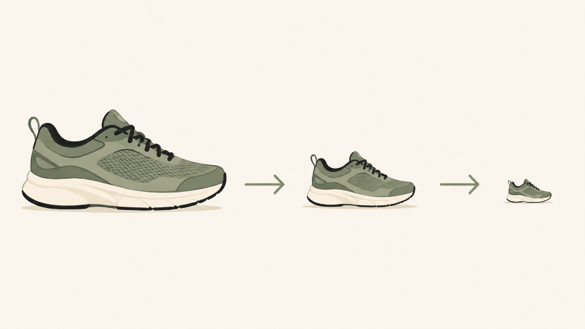
Whatever habit you picked, cut it down by half. Then cut it again. “Exercise for 30 minutes” becomes “put on my shoes and walk for 5 minutes.” “Read before bed” becomes “read one page.” This isn’t about lowering your standards forever — it’s about lowering the barrier to starting, because starting is where most habits die.
A five-minute walk sounds almost pointless. But a habit you’ll actually do beats a habit you’ll admire and never touch.
Step 3: Attach It to Something You Already Do
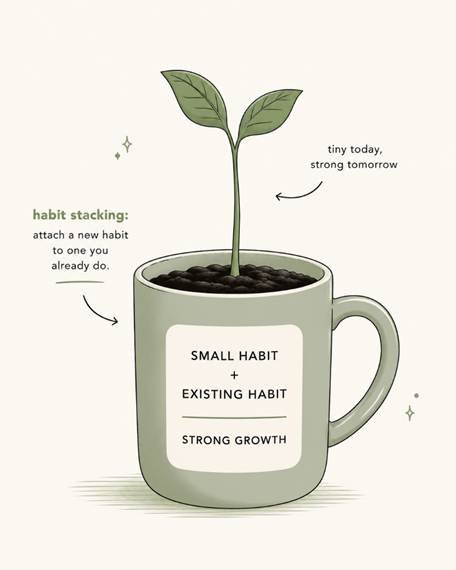
This is sometimes called habit stacking, and it works because you’re borrowing the momentum of an existing routine instead of building a new one from nothing [Research on habit stacking and cue-based behavior change]. Pair the new habit with something automatic: after you brush your teeth, after you sit down at your desk, after you pour your coffee.
Step 4: Track It Simply (Or Don’t Track It at All)
If tracking motivates you, keep it stupidly simple — a checkmark on a calendar, nothing more. If tracking has ever made you feel guilty or turned a habit into a chore, skip it entirely. Not everyone needs a system. Some people just need permission to do the small thing and move on with their day.
Step 5: Expect Bad Days — Build a Minimum Version

Every habit needs a “minimum viable version” for the days you’re running on empty. If your habit is a 20-minute walk, your minimum version might be walking to the mailbox and back. It sounds silly. Do it anyway. The goal on a bad day isn’t progress — it’s not breaking the pattern completely.
Step 6: Let It Take Longer Than You Want
Most research on habit formation suggests it can take anywhere from about three weeks to several months for a new behavior to start feeling automatic, depending on the habit and the person [Study on average time to habit automaticity]. That’s a wide range, and it’s supposed to be. Your habit isn’t broken if it still feels effortful after three weeks. It’s just not done cooking yet.
Realistic Self-Improvement Plan for Beginners

If you want a starting point rather than a menu of options, here’s one. This isn’t the only way to do it, but it’s a version that’s held up for a lot of tired, busy people.
Weeks 1–2: Choose one tiny habit. Something so small it feels almost pointless — one glass of water before coffee, one minute of stretching, one page of a book. Attach it to an existing routine. Don’t track anything yet. Just do the small thing.
Weeks 3–4: Once the first habit feels close to automatic, add a second — still small. Keep the first one running in the background. You’re not replacing habits, you’re layering them.
Month 2: Start noticing your own patterns. Which days do you skip? What’s the trigger — stress, exhaustion, a busy schedule? You’re not trying to eliminate the bad days. You’re trying to understand them so your minimum version fits reality.
Month 3 and beyond: Slowly increase the size of one habit if it genuinely feels easy — not because a plan on the internet said three months is when things should escalate. If it still feels hard, stay small longer. There’s no prize for rushing this.
This whole approach runs counter to a lot of “21-day challenge” advice you’ll see online, and honestly, I think that advice does more harm than good. It sets an expectation that’s disconnected from how actual behavior change works, and then people blame themselves when reality doesn’t match the marketing.
Common Mistakes That Undo Sustainable Self-Improvement
A few patterns show up again and again with people trying to build lasting habits:
- Restarting from scratch after a missed day. One skipped day is data, not failure. Restarting the whole plan wastes momentum you’d already built.
- Comparing your week 1 to someone else’s month 6. Social media makes this worse than it’s ever been. You’re seeing someone’s highlight reel, not their actual process.
- Adding a new habit before the last one sticks. Patience is the actual hard part here — harder than the habits themselves, most of the time.
- Treating rest as the opposite of progress. Recovery weeks aren’t a failure of discipline. Sometimes your body and brain genuinely need less input, not more willpower.
- Ignoring sleep and stress while trying to “improve.” It’s tough to build any new habit on top of chronic exhaustion. If sleep’s a mess, that’s often the actual first habit worth fixing. [Internally link to: sleep optimization article]
If stress is a bigger blocker for you than time, it’s worth reading about how overthinking and stress patterns quietly sabotage habit-building — that’s often the root issue hiding underneath a “lack of motivation.”
When to Get Extra Support
Small habit changes are usually safe for most healthy adults to try on their own. But if you’re dealing with significant burnout, symptoms of depression or anxiety, or a health condition that habit changes might affect (like diabetes, heart disease, or an eating disorder), it’s worth talking to a doctor or licensed therapist before making changes — especially around diet, sleep medication, or exercise intensity. Self-improvement should support your health, not work against it.
FAQ
How long does it take to build a sustainable habit?
Estimates vary, but many sources suggest it can take anywhere from a few weeks to several months, depending on the habit and the person [Study on habit formation timelines]. Simpler habits, like drinking a glass of water each morning, tend to stick faster than complex ones like a full workout routine.
Why do I keep failing at self-improvement even when I really want change?
Usually it’s not about willpower — it’s about the habit being too big, too rigid, or disconnected from your actual daily routine. Shrinking the habit and attaching it to something you already do tends to fix this faster than “trying harder.”
Is it bad to miss a day when building a new habit?
No. Missing one day rarely undoes progress. What matters more is what you do the next day — get back to it instead of treating the miss as a reason to quit completely.
Can I work on more than one habit at a time?
You can, but most people do better focusing on one habit until it feels close to automatic before adding another. Juggling several new habits at once is one of the most common reasons people burn out and abandon all of them.
What’s the difference between sustainable self-improvement and just being lazy about goals?
Sustainability isn’t about doing less because you don’t care — it’s about designing habits that survive your real schedule and energy levels, so you’re actually consistent instead of intense for two weeks and then done.