If you want to know how to start a home workout routine, here’s the short version: pick 3 days a week, do 20-30 minutes of bodyweight moves that hit your whole body, and stick with it for four weeks before judging results. You don’t need a gym membership, a garage full of dumbbells, or a perfect morning routine. You need a plan simple enough that you’ll actually follow it on a Tuesday when you’re tired and don’t feel like it.
Key Takeaways
- You can build real strength and fitness with zero equipment — bodyweight training works, [CITE: study or fitness authority on effectiveness of bodyweight resistance training for muscular strength in untrained adults].
- Beginners should aim for 3 workouts per week, not 6 — recovery is part of the process, not a skipped step.
- A full-body routine (not split by muscle group) is more efficient and more forgiving for people short on time.
- Consistency for 4 weeks matters more than intensity on day one.
- Progress by adding reps, slowing tempo, or reducing rest — not by needing new gear.
Why Home Workouts Actually Work (Even Without Equipment)
Let’s get the skepticism out of the way first, because I know it’s there. You’ve probably seen enough “10-minute ab workout” videos to be suspicious of anything that promises results without weights.
Here’s the thing: your body doesn’t know the difference between a barbell and its own bodyweight. Resistance is resistance. A push-up loads your chest, shoulders, and triceps in a way that’s mechanically similar to a bench press — just at a lower relative intensity for most people. Squats, lunges, and glute bridges build real lower-body strength using nothing but gravity and your own mass.
What equipment actually gives you is a way to keep increasing resistance once bodyweight training stops being challenging. For a true beginner, that point is further away than you’d think — often 8 to 12 weeks out, sometimes longer. So no, you’re not missing out. You’re just starting exactly where you should.
How Often Should Beginners Work Out at Home?
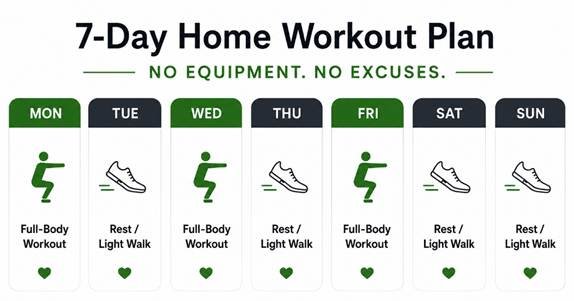
Three days a week. Not five. Not “every day I feel motivated.”
This is one of those pieces of advice I’ll push back on, because a lot of fitness content still glorifies daily training like rest is optional. It’s not. When you’re new to structured exercise, your muscles, joints, and connective tissue need 48 hours to recover and adapt between sessions [CITE: guideline on rest and recovery frequency for beginner strength training]. Skip that, and you’re not being disciplined — you’re just setting yourself up for burnout or a nagging injury in week three.
A realistic beginner schedule looks like this:
- Monday — Full-body workout (20-30 minutes)
- Tuesday — Rest or light walk
- Wednesday — Full-body workout
- Thursday — Rest or light walk
- Friday — Full-body workout
- Weekend — Rest, or an easy activity you actually enjoy
That’s it. Three sessions, roughly 90 minutes of total training time per week. If that sounds too easy to work, that’s kind of the point — it’s supposed to be sustainable, not heroic.
What Is a No-Equipment Home Workout Routine, Exactly?
A no-equipment home workout routine is a structured training plan using only your bodyweight — no dumbbells, resistance bands, or machines — organized into repeatable sessions that target your major muscle groups: legs, chest, back, shoulders, and core.
The key word is structured. Doing random push-ups whenever you remember isn’t a routine — it’s a hobby you’ll quit by February. A real routine has:
- A consistent schedule (same days each week)
- A repeatable set of exercises (so you can track progress)
- A clear way to make it harder over time
- A defined start and check-in point (4 weeks is a good first checkpoint)
That structure is what separates people who are still working out in month six from people who did three workouts in January and never touched it again.
Simple Home Workout Routine for Beginners (Step-by-Step)
Here’s a full-body routine you can start tomorrow. No warm-up gear needed — just do 5 minutes of light movement first (marching in place, arm circles, bodyweight squats) to get blood flowing.
Do this 3x per week, resting a day between sessions:
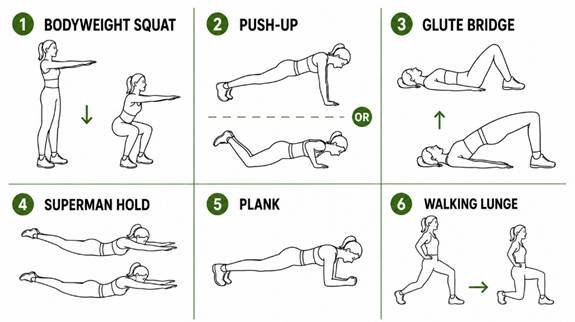
- Bodyweight Squats — 3 sets of 12-15 reps
Feet shoulder-width apart, sit back like you’re reaching for a chair, chest up. Keep your knees tracking over your toes, not caving in. - Push-Ups (knee push-ups if needed) — 3 sets of 8-12 reps
Hands slightly wider than shoulders. If a full push-up isn’t there yet, drop to your knees — that’s not “cheating,” that’s scaling a movement correctly. - Glute Bridges — 3 sets of 15 reps
Lie on your back, feet flat, drive your hips up by squeezing your glutes, not your lower back. - Bent-Over Reverse Fly (using your bodyweight and a slight hinge) or Superman Holds — 3 sets of 12 reps
This is the one people skip. Don’t. Your back muscles balance out all that pushing you’re doing elsewhere. - Plank — 3 sets, hold 20-40 seconds
Straight line from shoulders to heels. If your hips sag, you’re done for that set — quality over duration here. - Walking Lunges — 2 sets of 10 reps per leg
Step forward, drop the back knee toward the floor, push back up through the front heel.
Rest about 45-60 seconds between sets. The whole session runs 25-35 minutes depending on your pace.
How to Make It Harder Without Buying Equipment
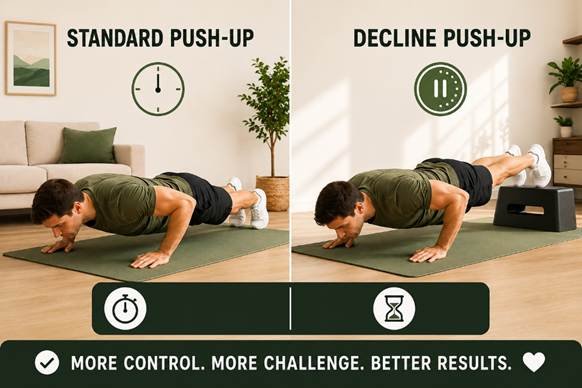
Once this feels too easy — usually around week 4 to 6 — you don’t need weights yet. You have other levers:
- Slow the tempo down. A 4-second lowering phase on a squat is brutal in a way a fast rep never will be.
- Add reps or a set. Go from 3 sets of 12 to 4 sets of 15.
- Shrink your rest. Cut rest periods from 60 seconds to 30.
- Move to a harder variation. Regular push-up → decline push-up (feet on a step) → eventually working toward one-arm progressions.
Common Beginner Mistakes to Avoid
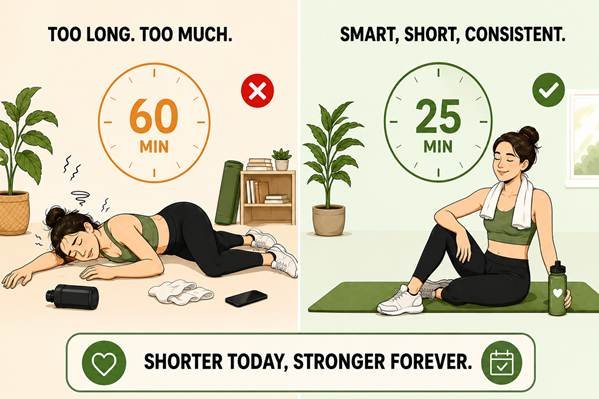
I’ll be honest — most people don’t fail at home workouts because the exercises are wrong. They fail for reasons that have nothing to do with fitness knowledge:
- Starting with an hour-long routine. You’ll do it twice and quit. Twenty-five minutes, three days a week, beats sixty minutes once and never again.
- Skipping rest days entirely. More isn’t better here — it’s just more.
- Comparing week one to someone else’s month six. Not helpful, and honestly a little unfair to yourself.
- No plan for progression. If you do the exact same workout for three months with zero change, your body stops adapting. That’s not laziness, that’s just how adaptation works.
- Training in a space that doesn’t work. You don’t need a home gym, but you do need enough floor space to lie down flat with your arms out. Figure that out before day one, not mid-lunge.
Do You Need a Doctor’s Clearance Before Starting?
If you’re generally healthy and new to exercise, a basic bodyweight routine like this one is considered low-risk for most adults [CITE: guidance from a major health authority on exercise clearance for healthy adults starting a new program]. That said, if you have a heart condition, joint issues, are pregnant, or haven’t exercised in years and have other health concerns, it’s worth checking in with a doctor first. This is general information, not a substitute for medical advice specific to you.
FAQ
How long should a beginner home workout be?
Somewhere between 20 and 35 minutes is the sweet spot. Long enough to train your whole body, short enough that you’ll actually do it on a busy weeknight.
Can you build muscle with just bodyweight exercises?
Yes, especially as a beginner. Bodyweight training provides enough resistance to build noticeable strength and muscle for the first several months of training [CITE: research on strength gains from bodyweight-only training in beginners]. Progress slows eventually, but that’s months away for most new exercisers.
What’s the best home workout routine for busy people?
A 3-day-a-week, full-body routine using compound moves (squats, push-ups, lunges) gets the most benefit for the least time invested — no need for 5-6 day splits when you’re just starting out.
Do I need a mat or any gear at all?
Not really. A towel or rug works fine for floor exercises. Comfortable clothes and a little floor space are the only real requirements.
How soon will I see results from a home workout routine?
Most beginners notice better energy and easier daily movement within 2-3 weeks, and visible strength or shape changes closer to 6-8 weeks with consistent training [CITE: timeline data on early strength and body composition changes in new exercisers].