

If you want to know how to stay healthy as a new dad, here’s the short version: you won’t do it perfectly, and that’s fine. The goal isn’t a six-pack or eight hours of sleep — it’s building small, repeatable habits around sleep, stress, movement, and connection that survive contact with a screaming newborn at 3 a.m.
That’s the whole article, honestly. Everything below is just the “how.”
Key Takeaways
- Sleep in chunks, not one block. Even 20-minute naps stacked up can meaningfully cut sleep debt.
- Stress management for new dads isn’t optional — untreated stress affects your patience, your relationship, and your immune system.
- You don’t need a gym. 10–15 minute bodyweight sessions, done consistently, beat a gym membership you never use.
- Self-care isn’t selfish. A depleted dad is a worse partner and parent than one who takes 20 minutes for himself.
- Postpartum depression and anxiety happen to dads too — and it’s worth knowing the signs.
What Does “Staying Healthy” Actually Mean for New Dads?
Let’s define this properly, because most advice aimed at new fathers is either too vague (“just prioritize self-care!”) or too demanding (“wake up at 5 a.m. for your cold plunge and journaling routine”).
For a first-time dad in the thick of it, staying healthy means covering four bases well enough — not perfectly:
- Sleep — protecting whatever sleep you can get, even if it’s fragmented.
- Stress regulation — having a way to bring your nervous system down from a 9 to a 5, regularly.
- Movement — enough physical activity to keep your energy and mood stable, not to hit a fitness goal.
- Connection — staying emotionally present with your partner and baby instead of just physically in the room.
Miss one of these for a week? Not a big deal. Miss all four for two months straight, and you’ll feel it — in your mood, your marriage, and honestly your waistline too.
How to Manage Stress as a First-Time Father

This is the piece nobody warns you about. You prep for the sleep loss. You buy the diapers in bulk. Nobody tells you that your baseline stress level is about to live somewhere it’s never lived before, and stay there for months.
Here’s what’s actually happening in your body: chronic sleep loss and constant low-grade vigilance (is the baby okay? did she just cough weird?) keep cortisol elevated longer than it’s designed to be [Study on cortisol and chronic sleep deprivation]. That’s not a mindset problem. It’s physiology.
A few things that genuinely help, in order of how little time they take:
- Box breathing for 90 seconds. In for 4, hold for 4, out for 4, hold for 4. Do it in the car before you walk inside. It sounds too simple to work — it works.
- Name it out loud. “I’m really stressed right now” — said to your partner, a friend, or even just yourself — does something that silently gritting your teeth doesn’t. Research on affect labeling suggests naming an emotion can reduce its intensity [Study on affect labeling and amygdala activity].
- Lower the bar on purpose. Decide in advance that the house being messy for six months is acceptable. Fighting that reality is a stress tax you don’t need to pay right now.
- Get 10 minutes outside, daily, ideally with sunlight on your face — this one sounds like wellness-influencer fluff, but morning light exposure is genuinely linked to better mood regulation and circadian rhythm stability.
One thing I’ll push back on: the advice to “just communicate more” with your partner. It’s true, but it’s also useless without a specific ask. “Let’s talk more” goes nowhere at 11 p.m. when you’re both exhausted. “Can we do a 5-minute check-in every night after she’s down” actually happens, because it’s concrete.
Sleep Deprivation Tips for New Dads (Because You’re Not Getting 8 Hours)
Let’s be honest about something most sleep advice ignores: you cannot “sleep hygiene” your way out of a newborn waking every two hours. Blackout curtains won’t fix that. The goal here isn’t perfect sleep — it’s damage control.
What actually moves the needle:
- Split the night into shifts. If you and your partner can trade “on-call” blocks (say, 9 p.m.–1 a.m. and 1 a.m.–5 a.m.), each of you gets one guaranteed stretch of uninterrupted sleep. This beats both of you being half-awake all night.
- Nap without guilt. A 20-minute nap won’t fix sleep debt, but stacked over a week, short naps measurably reduce fatigue and improve alertness. Set an alarm — anything past 30 minutes and you risk grogginess (sleep inertia) that makes things worse.
- Protect your sleep environment for the hours you do get. Cooler room (around 65°F / 18°C), phone out of arm’s reach, no scrolling “just for five minutes” once the baby’s down. That five minutes always turns into forty.
- Watch caffeine timing, not just amount. Caffeine has a half-life of roughly 5–6 hours [Pharmacology source on caffeine half-life], so that 3 p.m. coffee is still partly in your system at 9 p.m., making an already hard night harder.
- Track sleep debt like a bank balance, not a daily failure. You’re not going to “catch up” this week. You’re managing a deficit for months. That reframe alone takes some pressure off.
If you’re consistently getting under 4–5 hours a night for weeks and noticing memory issues, irritability that scares you, or you’re falling asleep dangerously (driving, holding the baby), talk to your doctor. Chronic severe sleep deprivation is a real medical concern, not just a parenting rite of passage.
Quick Workouts for Dads With No Time
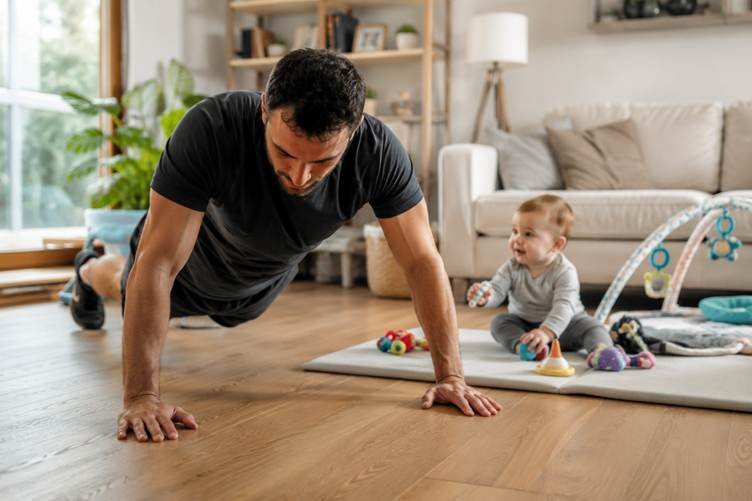
Here’s the mental shift that matters more than any specific workout: stop thinking of exercise as a 45–60 minute gym session. That version of fitness is dead for the next year or so. Replace it with movement snacks — short bursts, multiple times a day, that add up.
A realistic 12-minute bodyweight session you can do in the living room while the baby naps or plays on a mat nearby:
- Bodyweight squats — 40 seconds on, 20 seconds rest
- Push-ups (knee push-ups are fine) — 40 seconds on, 20 seconds rest
- Reverse lunges, alternating legs — 40 seconds on, 20 seconds rest
- Plank — 40 seconds on, 20 seconds rest
- Repeat the circuit twice
That’s it. Twelve minutes, no equipment, no gym drive time. Research on short, frequent exercise bouts (sometimes called “exercise snacking”) suggests it can produce comparable fitness benefits to longer sessions for time-crunched adults.
Other low-effort options that actually happen in real life:
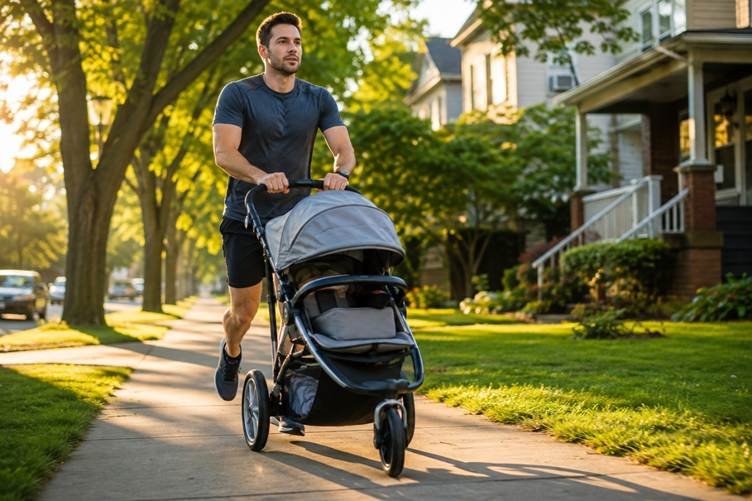
- Stroller walks count. A 25-minute walk pushing a stroller is genuinely good cardio, and it doubles as baby-soothing time.
- Baby-weighted squats and step-ups — once your pediatrician clears it and baby has decent head control, holding your baby (or a carrier) adds resistance to basic movements. Skip anything with impact or bouncing that jars a very young infant.
- The “one set while the kettle boils” method. Ten squats, ten push-ups, whatever — squeezed into 90-second gaps throughout the day. It’s not glamorous. It works.
Always check with your doctor before starting a new exercise routine, especially if you’re returning from a period of inactivity or have an existing health condition.
[Internally link to: strength training for beginners article]
Self-Care Tips for New Fathers That Aren’t Selfish

There’s a weird guilt that shows up for a lot of new dads around taking any time for themselves. You watch your partner recovering physically from birth, doing the bulk of feeding if she’s breastfeeding, and it can feel wrong to ask for 20 minutes to shower without someone banging on the door.
But here’s the thing — you being depleted doesn’t help anyone. A dad running on fumes, resentment, and zero personal time is more likely to be short-tempered, checked out, or running on autopilot. That’s not a moral failing, it’s just biology catching up with him.
Practical self-care that fits into a newborn schedule:
- Protect one non-negotiable thing per day, even if it’s just a 10-minute coffee alone before anyone wakes up.
- Text one friend a week. Isolation creeps in fast during the newborn stage, and social connection is one of the strongest buffers against stress and low mood.
- Ask for specific help, not general help. “Can you take the baby from 7–8 tonight so I can go for a run” gets a yes far more often than “I could use a break sometime.”
- Don’t skip meals. Sounds basic. It’s the first thing that goes when you’re overwhelmed, and low blood sugar makes stress and irritability worse.
And this needs saying plainly: postpartum depression and anxiety aren’t just a “mom thing.” Studies estimate a meaningful percentage of new fathers experience depressive symptoms in the first year [Statistic on paternal postpartum depression prevalence], often showing up as irritability, anger, or withdrawal rather than sadness — which is part of why it’s under-recognized. If you’re feeling persistently flat, angry, or disconnected for more than two weeks, that’s worth a conversation with a doctor or therapist, not something to push through solo.
How to Stay Healthy as a New Dad Long-Term

The newborn phase is temporary, even when it doesn’t feel like it. What you’re really building right now isn’t a perfect routine — it’s the habit of checking in with yourself at all, even briefly, even badly.
Around the 3–4 month mark, most families find some rhythm. That’s usually when it’s worth revisiting your sleep, stress, and movement habits and upgrading from “survival mode” to something more sustainable — slightly longer workouts, a proper wind-down routine, maybe therapy if stress has been sitting heavy.
Until then? Chunked sleep, a 12-minute workout, one honest conversation with your partner, and knowing the signs of paternal postpartum depression. That’s a genuinely solid foundation. Don’t let anyone — including your own inner critic — convince you it needs to be more than that right now.
FAQ
How can a new dad stay healthy with no free time?
Focus on small, stackable habits instead of big time blocks: short bodyweight workouts (10–15 minutes), naps under 30 minutes, and brief daily stress-reset practices like box breathing. Consistency in small doses beats occasional big efforts.
Do new dads get postpartum depression?
Yes. Research suggests a meaningful percentage of first-time fathers experience depressive symptoms in the year after birth [Statistic on paternal postpartum depression prevalence], often presenting as irritability or withdrawal rather than classic sadness. If symptoms last more than two weeks, it’s worth speaking to a doctor.
How much sleep do new dads actually need?
Adults generally need 7–9 hours, but most new parents won’t hit that for months. The realistic goal is minimizing total sleep debt through naps and shift-splitting with your partner, not chasing a perfect number.
What’s a quick workout for a dad with a newborn?
A 12-minute bodyweight circuit — squats, push-ups, lunges, and planks in 40-second intervals — done in your living room requires no equipment and no gym time, and can be repeated two to three times a week.
How do new dads deal with stress and lack of sleep?
A combination of short breathing exercises, brief daily outdoor time, honest and specific communication with a partner, and realistic (lowered) expectations for the first few months tends to help most. Chronic, severe symptoms warrant a conversation with a healthcare provider.